All places in 더블린

Merrion Square is a Georgian garden square on the southside of Dublin city centre.
Source: Wikipedia
Saint Anne's Park is a 240-acre (97 ha) public park situated between Raheny and Clontarf, suburbs on the northside of Dublin, Ireland. It is owned and managed by Dublin City Council.
Source: Wikipedia
The Garden of Remembrance is a memorial garden in Dublin dedicated to the memory of "all those who gave their lives in the cause of Irish Freedom".
Source: Wikipedia
Marlay Park is a 121 hectares suburban public park located in Rathfarnham in Dún Laoghaire–Rathdown, Ireland. Lying about nine kilometres from Dublin city centre, the parkland comprises woodlands, ponds and walks.
Source: Wikipedia
The Wellington Monument, or sometimes the Wellington Testimonial, is an obelisk located in the Phoenix Park, Dublin, Ireland.
Source: Wikipedia
The Irish National War Memorial Gardens is an Irish war memorial in Islandbridge, Dublin, dedicated "to the memory of the 49,400 Irish soldiers who gave their lives in the Great War, 1914–1918", out of a total of 206,000 Irishmen who served in the British forces alone during…
Source: Wikipedia
Fitzwilliam Square is a Georgian garden square in the south of central Dublin, Ireland. It was the last of the five Georgian squares in Dublin to be built, and is the smallest.
Source: Wikipedia
The Iveagh Gardens is a public park located between Clonmel Street and Upper Hatch Street, near the National Concert Hall in Dublin, Ireland. It is a national, as opposed to a municipal park, and designated as a National Historic Property.
Source: Wikipedia
The Oscar Wilde Memorial Sculpture is a collection of three statues in Merrion Square in Dublin, Ireland, commemorating Irish poet and playwright Oscar Wilde. The sculptures were unveiled in 1997 and were designed and made by Danny Osborne.
Source: Wikipedia
Herbert Park is the name of a road and a public park in Ballsbridge, Dublin.
Source: Wikipedia
During World War II, Dublin was first bombed early on the morning of 2 January 1941, when German bombs were dropped on the Terenure area.
Source: Wikipedia
Blessington Street Basin is a former drinking water reservoir in northern central Dublin which operated from 1810 until the 1970s, serving the north city. It became the central feature of a public park in 1891, and this park was renewed and reopened in 1994.
Source: Wikipedia
The O'Connell Monument is a 40 ft high commemorative granite and bronze monument honouring nationalist leader Daniel O'Connell (1775–1847) located on O'Connell Street, the main thoroughfare of Dublin, Ireland.
Source: Wikipedia
The Fusiliers' Arch is a monument which forms part of the Grafton Street entrance to St Stephen's Green park, in Dublin, Ireland.
Source: Wikipedia
Dartmouth Square is a Victorian Garden square located near Ranelagh, in Dublin, Ireland. It has a simple rectangular layout, including a low granite plinth wall, a pergola and its walkway, and broadleaf mature trees which enclose the space.
Source: Wikipedia
Stardust Memorial Park is a memorial park located in Coolock, Dublin, Ireland which was built to commemorate the lives of those who died in the Stardust night club fire on 14 February 1981.
Source: Wikipedia
A zoo in Dublin.

Kilmainham Gaol is a former prison in Kilmainham, Dublin. It is now a museum run by the Office of Public Works, an agency of the Government of Ireland.
Source: Wikipedia
Wolfe Tone Park, also known as Wolfe Tone Square, is a public space in Dublin, Ireland. It is bounded by Mary Street to the north, Jervis Street to the east, and Wolfe Tone Street to the west.
Source: Wikipedia
Rathfarnham Castle is a 16th-century fortified house in Rathfarnham, South Dublin, Ireland. Originally a semi-fortified and battlemented structure, it underwent extensive alterations in the 18th century. It is in the care of the state, has been restored and is open to the public.
Source: Wikipedia
St. Enda's Park is a mid-size public park in Rathfarnham, Dublin, Ireland. The park, which is approximately 20 hectares in size, contains the Pearse Museum and a café. It is held by the Irish state, and managed by the Office of Public Works.
Source: Wikipedia
Albert College Park, also known as Hampstead Park, is a public park owned by Dublin City Council and managed by the council's Parks and Landscape Services division. It is located in northern Glasnevin, in the mid-northern suburbs of Dublin.
Source: Wikipedia
Mount Pleasant Square is a Georgian garden square on the border of Rathmines and Ranelagh, in the city of Dublin, Ireland.
Source: Wikipedia
Tymon Park is a large suburban public park in Dublin, Ireland. It has an area of over 300 acres (120 ha) and is divided in two by the M50 motorway, the two divisions being linked by a pair of pedestrian bridges.
Source: Wikipedia
Father Collins Park is a public park located in Dublin, Ireland, near the boundary of Dublin city and Fingal. Its official address is Donaghmede, and it is located near the new development at Clongriffin, with Balgriffin a little to the west.
Source: Wikipedia
Pearse Square is a Georgian garden square in Dublin, Ireland. It is bounded on its southern side by Pearse Street.
Source: Wikipedia
Griffith Park is a 7.5-hectare (19-acre) park located on the banks of the River Tolka in Dublin city, Ireland between the suburbs of Glasnevin and Drumcondra.
Source: Wikipedia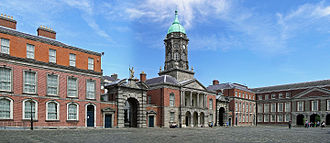
An attraction in Dublin.

The Casino at Marino is a Neo-Classical summer or pleasure house, originally located in the grounds of Marino House in Dublin, Ireland.
Source: Wikipedia
Clondalkin Round Tower is an Irish round tower located in Clondalkin, South Dublin, Ireland. Located on the site of a monastery founded by Saint Mochua, the tower is protected as a national monument.
Source: Wikipedia
An attraction in Dublin.

An attraction in Dublin.

An attraction in Dublin.

An attraction in Dublin.

Fairview is an inner coastal suburb of Dublin in Ireland, in the jurisdiction of Dublin City Council and in the city's D03 postal district. Part of the area forms Fairview Park, a recreational amenity laid out on land reclaimed from the sea.
Source: Wikipedia
St Stephen's Green is a garden square and public park located in the city centre of Dublin, Ireland. The current landscape of the park was designed by William Sheppard. It was officially re-opened to the public on Tuesday, 27 July 1880 by Lord Ardilaun.
Source: Wikipedia
An attraction in Dublin.

Temple Bar is an area on the south bank of the River Liffey in central Dublin, Ireland. The area is bounded by the Liffey to the north, Dame Street to the south, Westmoreland Street to the east and Fishamble Street to the west.
Source: Wikipedia
An attraction in Dublin.

The Cabbage Garden, also known as the Cabbage Patch, is a former burial ground in Dublin, Ireland. It is located off Upper Kevin Street in Dublin's south inner city. Used as a cemetery from 1666 until the 1890s, it is now laid-out as a public park.
Source: Wikipedia
The Ha'penny Bridge, known later for a time as the Penny Ha'penny Bridge, and officially the Liffey Bridge, is a pedestrian bridge built in May 1816 over the River Liffey in Dublin, Ireland. Made of cast iron, the bridge was cast in Shropshire, England.
Source: Wikipedia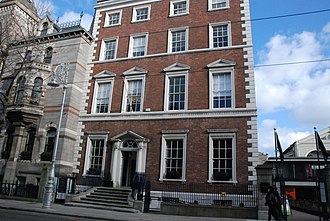
The Royal Irish Academy, based in Dublin, is an academic body that promotes study in the natural sciences, arts, literature, and social sciences. It is Ireland's premier learned society and one of its leading cultural and academic institutions.
Source: Wikipedia
Farmleigh is the official Irish state guest house. It was formerly one of the Dublin residences of the Guinness family. It is situated on an elevated position above the River Liffey to the northwest of the Phoenix Park, in Castleknock.
Source: Wikipedia
Guinness Storehouse is a tourist attraction at St. James's Gate Brewery in Dublin, Ireland. Since opening in 2000, it has received over twenty million visitors.
Source: Wikipedia
The Dunsink Observatory is an astronomical observatory established in 1785 in the townland of Dunsink in the outskirts of the city of Dublin, Ireland.
Source: Wikipedia
The Hungry Tree is a tree in the grounds of the King's Inns in Dublin, Ireland. An otherwise unremarkable specimen of the London plane, it has become known for having partially consumed a nearby park bench. It has become a tourist attraction and is frequently photographed.
Source: Wikipedia
The City Hall, Dublin, originally the Royal Exchange, is a civic building in Dublin, Ireland. It was built between 1769 and 1779, to the designs of architect Thomas Cooley, and is a notable example of 18th-century architecture in the city.
Source: Wikipedia
The Convention Centre Dublin is a convention centre in the Dublin Docklands, Ireland. The Convention centre overlooks the River Liffey at Spencer Dock. It was designed by the Irish-born American architect Kevin Roche.
Source: Wikipedia
Marsh's Library formerly St. Sepulchre's Library, situated in St. Patrick's Close, adjacent to St. Patrick's Cathedral and St. Sepulchre's Palace, Dublin, Ireland is a well-preserved library of the late Renaissance and early Enlightenment.
Source: Wikipedia
The Stone of Remembrance is a standardised design for war memorials that was designed in 1917 by the British architect Sir Edwin Lutyens for the Imperial War Graves Commission (IWGC).
Source: Wikipedia