All places in 델리

Jantar Mantar in New Delhi is an observatory, designed to be used with the naked eye. It is one of five Jantar Mantar in India. "Jantar Mantar" means "instruments for measuring the harmony of the heavens". It consists of 13 architectural astronomy instruments.
Source: Wikipedia
The Chandni Chowk is a street market square it is one of the oldest and busiest markets in Old Delhi, India. Located close to the Old Delhi railway station, the Mughal-era Red Fort is located at the eastern fringes of Chandni Chowk.
Source: Wikipedia
The Teen Murti Bhavan is a building and former residence in New Delhi. It was built by the British Raj and became the residence of the first Prime Minister of India, Jawaharlal Nehru, who stayed there for 16 years until his death on 27 May 1964.
Source: Wikipedia
The Feroz Shah Kotla or Kotla was a fortress built circa 1354 by Feroz Shah Tughlaq to house his version of Delhi called Firozabad.
Source: Wikipedia
Salimgarh Fort was built in 1546 CE in Old Delhi, on what was then an island of the Yamuna River, by Salim Shah Suri, the son of Sher Shah Suri.
Source: Wikipedia
Asaf Jah Jamat-ul-Mulk Shuja-ud-Daula Nawab Abul Mansur Khan Bahadur Safdar Jang Sipah Salar, better known as Safdar Jang, was the second Nawab of Kingdom of Awadh succeeding Saadat Khan in the year 1739 and Mughal Grand Vizier from 1748 to 1753.
Source: Wikipedia
Dilli Haat is a paid-entrance open-air market, food plaza, and craft bazaar located in Delhi. The area is run by Delhi Tourism and Transportation Development Corporation (DTTDC), and unlike the traditional weekly market, the village Haat, Dilli Haat is permanent.
Source: Wikipedia
Mīrzā Najaf Khān Bahādur, simply known as Mirza Najaf Khan was a Mughal nobleman and adventurer of Safavid lineage who came to Delhi around 1740 from Iran after Nader Shah had displaced the Safavid dynasty in 1736. He became a courtier of Mughal emperor Shah Alam II.
Source: Wikipedia
The Diwan-i-Am, or Hall of Audience, is a building in the Red Fort of Old Delhi where the Mughal emperor Shah Jahan (1592–1666) and his successors received members of the general public and heard their grievances.
Source: Wikipedia
Moth ki Mosque is a 16th-century mosque located in the South Delhi district of India. The mosque was built in 1505 by Wazir Miya Bhoiya, Prime Minister during the reign of Sikander Lodi of the Lodi dynasty.
Source: Wikipedia

An attraction in Delhi.
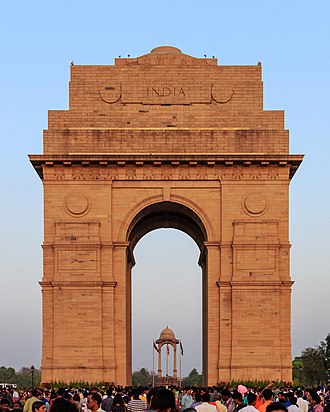
An attraction in Delhi.

An attraction in Delhi.

Purana Qila is one of the oldest forts in Delhi, India. It was built by the second Mughal Emperor Humayun and Surid Sultan Sher Shah Suri. The fort forms the inner citadel of the city of Dinpanah.
Source: Wikipedia
Delhi Gate is the southern gate in the historic walled city of Delhi, or Shahjahanabad in 1638 AD. The gate links the New Delhi city with the old walled city of Delhi. It stands in the middle of the road, at the end of Netaji Subhash Chandra Road, at the edge of Daryaganj.
Source: Wikipedia
Khooni Darwaza, also referred to as Lal Darwaza was initially called as Kabuli Darwaza, The gate is located near Delhi Gate, on the Bahadur Shah Zafar Marg in Delhi, India. It is one of the 13 surviving gates in Delhi.
Source: Wikipedia
An attraction in Delhi.

Arab Serai is a 16th century caravanserai within the Humayun's tomb complex at Delhi, India. It is said to have been built by Mughal emperor Humayun's widow Haji Begum. In recent times, it has been conserved by Aga Khan Trust for Culture.
Source: Wikipedia
Barakhamba, also known as Barakhamba Monument, is a 14th-century tomb building from the Tughlaq period that is located in New Delhi, India. Barakhamba means '12 Pillars' in Urdu and Hindi languages.
Source: Wikipedia
Kashmiri Gate, also spelled Kashmere Gate, is a historic gate located in Old Delhi, Delhi, India. It served as the northern entrance to the walled city of Shahjahanabad, the capital of the Mughal Empire.
Source: Wikipedia