All places in 델리

Jantar Mantar in New Delhi is an observatory, designed to be used with the naked eye. It is one of five Jantar Mantar in India. "Jantar Mantar" means "instruments for measuring the harmony of the heavens". It consists of 13 architectural astronomy instruments.
Source: Wikipedia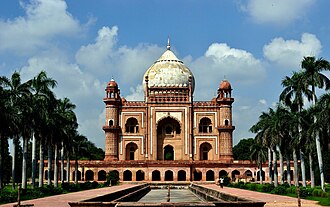
Safdarjung's tomb is a sandstone and marble mausoleum in Delhi, India. It was built in 1754 in the late Mughal Empire style for Nawab Safdarjung.
Source: Wikipedia
The Chandni Chowk is a street market square it is one of the oldest and busiest markets in Old Delhi, India. Located close to the Old Delhi railway station, the Mughal-era Red Fort is located at the eastern fringes of Chandni Chowk.
Source: Wikipedia
The Teen Murti Bhavan is a building and former residence in New Delhi. It was built by the British Raj and became the residence of the first Prime Minister of India, Jawaharlal Nehru, who stayed there for 16 years until his death on 27 May 1964.
Source: Wikipedia
The National Zoological Park is a 176-acre (71 ha) zoo in New Delhi, India.
Source: Wikipedia
The Feroz Shah Kotla or Kotla was a fortress built circa 1354 by Feroz Shah Tughlaq to house his version of Delhi called Firozabad.
Source: Wikipedia
Lodi Gardens is a city park situated in New Delhi. Spread over 90 acres (360,000 m2), it contains Muhammad Shah's tomb, the tomb of Sikandar Lodi, the Shisha Gumbad and the Bara Gumbad.
Source: Wikipedia
Salimgarh Fort was built in 1546 CE in Old Delhi, on what was then an island of the Yamuna River, by Salim Shah Suri, the son of Sher Shah Suri.
Source: Wikipedia
Dilli Haat is a paid-entrance open-air market, food plaza, and craft bazaar located in Delhi. The area is run by Delhi Tourism and Transportation Development Corporation (DTTDC), and unlike the traditional weekly market, the village Haat, Dilli Haat is permanent.
Source: Wikipedia
Sunder Nursery, formerly called Azim Bagh or Bagh-e-Azeem, is a 16th-century heritage park complex adjacent to the Humayun's Tomb, a UNESCO World Heritage Site in Delhi.
Source: Wikipedia
The Hazrat Nizamuddin Dargah is the dargah and mosque complex of the Sufi saint Nizamuddin Auliya, located in the Nizamuddin West area of Delhi, India. The dargah, or mausoleum, is a Sufi shrine and is visited by thousands of pilgrims every week.
Source: Wikipedia
Coronation Park is a park located at Burari Road near Nirankari Sarovar in Delhi, India. It was the venue of the Delhi Durbar of 1877 when Queen Victoria was proclaimed the Empress of India.
Source: Wikipedia
Moth ki Mosque is a 16th-century mosque located in the South Delhi district of India. The mosque was built in 1505 by Wazir Miya Bhoiya, Prime Minister during the reign of Sikander Lodi of the Lodi dynasty.
Source: Wikipedia
The Diwan-i-Am, or Hall of Audience, is a building in the Red Fort of Old Delhi where the Mughal emperor Shah Jahan (1592–1666) and his successors received members of the general public and heard their grievances.
Source: Wikipedia
Mīrzā Najaf Khān Bahādur, simply known as Mirza Najaf Khan was a Mughal nobleman and adventurer of Safavid lineage who came to Delhi around 1740 from Iran after Nader Shah had displaced the Safavid dynasty in 1736. He became a courtier of Mughal emperor Shah Alam II.
Source: Wikipedia
Khawaja Syed Muhammad b. Ahmad Ali al-Badaoni al-Bukhari, popularly called Nizamuddin Auliya, also known as Hazrat Nizamuddin, Sultan-ul-Mashaikh and Mahbub-e-Ilahi, was an Indian Sunni Muslim scholar, Sufi saint of the Chishti Order, and is one of the most famous Sufis from…
Source: Wikipedia
The National War Memorial is a war memorial in New Delhi, Delhi, India, located at India Gate Circle. It has been built to honour and remember soldiers of the Indian Armed Forces who fought in armed conflicts of independent India.
Source: Wikipedia
The Diwan-i-Khas, or Hall of Private Audiences, was a chamber in the Red Fort of Old Delhi built in 1648 as a location for receptions. It was the location where the Mughal Emperor Shah Jahan received courtiers and state guests. It was also known as the Shah Mahal.
Source: Wikipedia
The National Police Memorial in India commemorates the 34,844 police personnel from all of the central and state police forces in India who have died in the line of duty since the nation's Independence in 1947.
Source: Wikipedia
Arab Serai is a 16th century caravanserai within the Humayun's tomb complex at Delhi, India. It is said to have been built by Mughal emperor Humayun's widow Haji Begum. In recent times, it has been conserved by Aga Khan Trust for Culture.
Source: Wikipedia
Aurangzeb's Sheesh Mahal Garden is a Mughal garden located in Shalimar Bagh, Delhi, India. It was named as Aizzabad Bagh when the garden was laid by Izz-un-Nissa wife of Mughal emperor Shah Jahan in 1653 as a tribute and replica of Shalimar Bagh, Kashmir, laid by erstwhile…
Source: Wikipedia
The Bara Gumbad is a medieval monument located in Lodi Gardens in Delhi, India. It is part of a group of monuments that include a Friday mosque and the "mehman khana" of Sikandar Lodi, the ruler of the Delhi Sultanate.
Source: Wikipedia
The Millennium Park is a park on the Outer Ring Road in the east of Delhi, India. It was constructed in 2004 by the Delhi Development Authority. The park includes a children's park, an amphitheatre and a food court.
Source: Wikipedia
A monument in Delhi.

Talkatora Garden is a Mughal-era garden situated on the Mother Teresa Crescent in New Delhi. During the Mughal era, it used to be a tank and a swimming pool.
Source: Wikipedia
The Mutiny Memorial, now known as Ajitgarh, is a memorial situated on the Ridge New Delhi. It was built to commemorate the Delhi Field Force during the Indian Revolt of 1857 and bears the names of some of the British officers and men who were killed.
Source: Wikipedia
Keventers Milkshake is an Indian milkshake brand and chain of restaurants and kiosks that began operating in 1925. The brand mostly dissolved in the 1970s and was revived starting in 2014. It is owned by Super Milk Products Private Limited.
Source: Wikipedia
Karim's Hotel or Karim's is an international chain of restaurants headquartered in Old Delhi in Delhi, India. Established in 1913, the original location in the Jama Masjid area of Delhi was founded by Haji Karimuddin, a cook from the royal court of Mughal Emperor Bahadur Shah…
Source: Wikipedia
Sabz Burj is an octagonal Mughal-era mausoleum situated at an intersection on Mathura Road, near Nizamuddin complex, west of Humayun's Tomb, Delhi.
Source: Wikipedia
The statue of Subhas Chandra Bose, also known as the Netaji's Statue, is a monolithic statue made of black granite, dedicated to Netaji Subhas Chandra Bose, commander-in-chief of the Axis-aligned Indian National Army.
Source: Wikipedia

An attraction in Delhi.

Shish Gumbad, also spelt Shisha Gumbad, is a tomb from the Lodi dynasty and is thought to have possibly been constructed between 1489 and 1517 CE; the historian Simon Digby has argued on the basis of an inscription in the adjoining mosque that it was completed in 1494 CE.
Source: Wikipedia
The Jaipur Column is a monumental column in the middle of the courtyard in front of Rashtrapati Bhavan, the presidential residence in New Delhi, Delhi, India.
Source: Wikipedia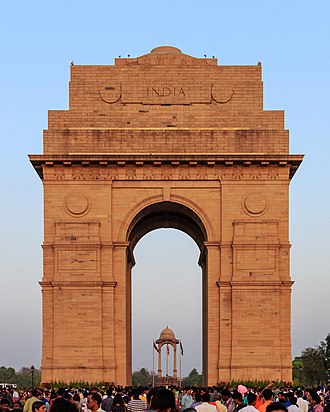
An attraction in Delhi.

An attraction in Delhi.
The Diwan-i-Am, or Hall of Audience, is a building in the Red Fort of Old Delhi where the Mughal emperor Shah Jahan (1592–1666) and his successors received members of the general public and heard their grievances.
Source: Wikipedia
Sher Mandal is a 16th-century historic Library within the Purana Qila fort located in Delhi, India. Designed in a blend of Indo-islamic, Timurid and Persian architecture, it is the only surviving palace structure within the fort and has become a tourist attraction.
Source: Wikipedia
Chausath Khamba, also spelled Chaunsath Khamba, is a tomb built during 1623–24. It is located in Nizamuddin precincts of Sufi Muslim shrines and tombs in New Delhi, India. The name means "64 pillars" in Urdu and Hindi.
Source: Wikipedia
The Ashokan edicts in Delhi are a series of edicts on the teachings of Buddha created by Ashoka, the Mauryan Emperor who ruled in the Indian subcontinent during the 3rd century BC.
Source: Wikipedia
Purana Qila is one of the oldest forts in Delhi, India. It was built by the second Mughal Emperor Humayun and Surid Sultan Sher Shah Suri. The fort forms the inner citadel of the city of Dinpanah.
Source: Wikipedia
Delhi Ridge, sometimes simply called The Ridge, is a ridge in the Northern Aravalli leopard wildlife corridor in the National Capital Territory of Delhi in India.
Source: Wikipedia
Delhi Gate is the southern gate in the historic walled city of Delhi, or Shahjahanabad in 1638 AD. The gate links the New Delhi city with the old walled city of Delhi. It stands in the middle of the road, at the end of Netaji Subhash Chandra Road, at the edge of Daryaganj.
Source: Wikipedia
The Khas Mahal served as the Mughal emperor's private residence in Old Delhi. The structure is located inside the Red Fort, which is a large defensive and governmental complex located inside the city.
Source: Wikipedia
Khooni Darwaza, also referred to as Lal Darwaza was initially called as Kabuli Darwaza, The gate is located near Delhi Gate, on the Bahadur Shah Zafar Marg in Delhi, India. It is one of the 13 surviving gates in Delhi.
Source: Wikipedia
An attraction in Delhi.

The Rang Mahal or Palace of Colour is located in the Red Fort, Old Delhi.
Source: Wikipedia
Barakhamba, also known as Barakhamba Monument, is a 14th-century tomb building from the Tughlaq period that is located in New Delhi, India. Barakhamba means '12 Pillars' in Urdu and Hindi languages.
Source: Wikipedia
Kashmiri Gate, also spelled Kashmere Gate, is a historic gate located in Old Delhi, Delhi, India. It served as the northern entrance to the walled city of Shahjahanabad, the capital of the Mughal Empire.
Source: Wikipedia
A park in Delhi.